Pronoun (Basic ㊦ 159)
A reflexive pronoun that refers (back) to a human subject with whom the speaker is empathising.
Equivalent: ~ self; own
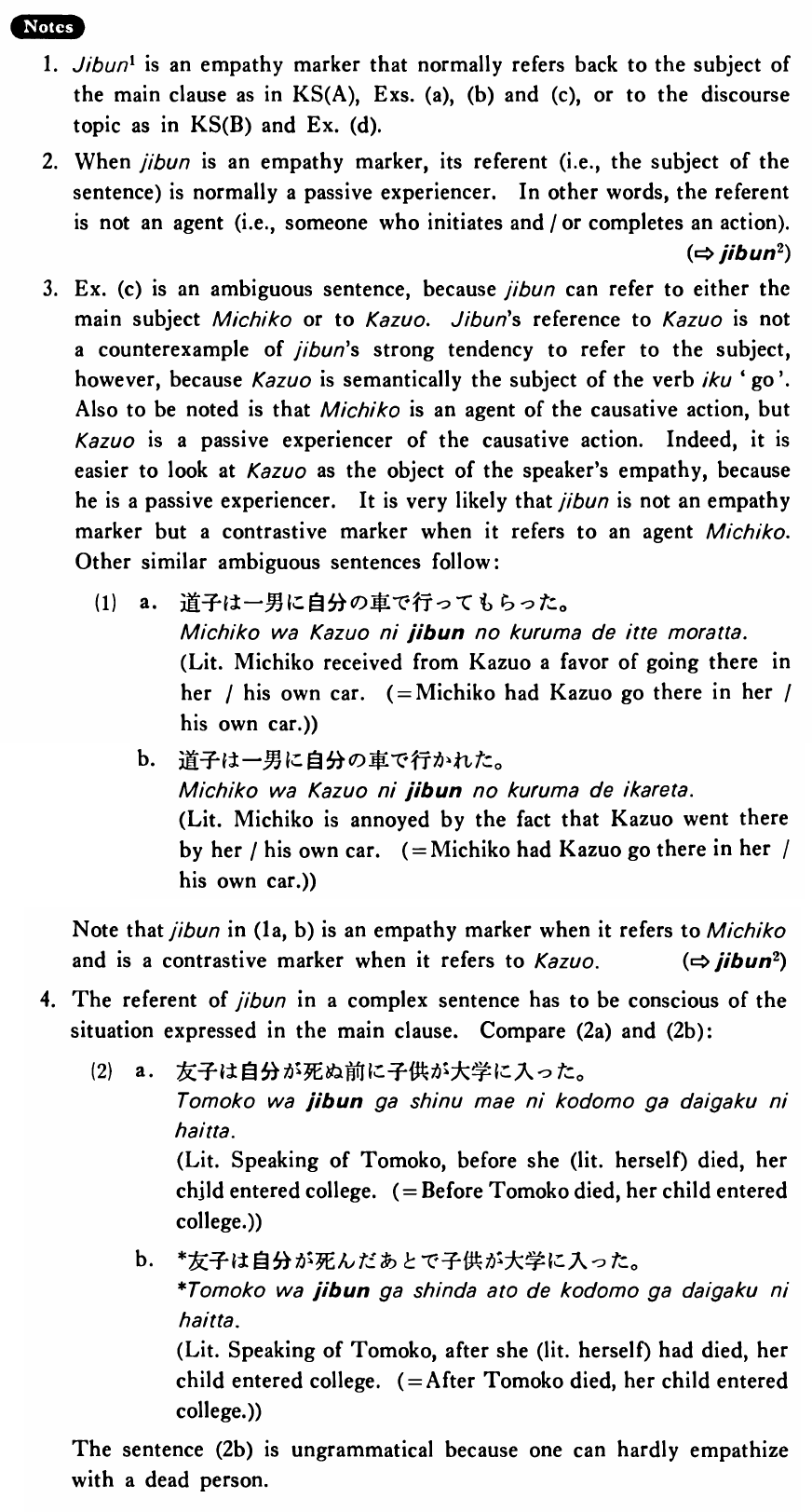
1. 自分1 is an empathy marker that normally refers back to the subject of the main clause as in Key Sentence (A), Examples (a), (b) and (c), or to the discourse topic as in Key Sentence (B) and Example (d).
2. When 自分 is an empathy marker, its referent (i.e., the subject of the sentence) is normally a passive experiencer. In other words, the referent is not an agent (i.e., someone who initiates and/or completes an action).
(⇨ 自分2)
3. Example (c) is an ambiguous sentence, because 自分 can refer to either the main subject Michiko or to Kazuo. 自分's reference to Kazuo is not a counter example of 自分's strong tendency to refer to the subject, however, because Kazuo is semantically the subject of the verb 行く 'go'. Also to be noted is that Michiko is an agent of the causative action, but Kazuo is a passive experiencer of the causative action. Indeed,it is easier to look at Kazuo as the object of the speaker's empathy, because he is a passive experiencer. It is very likely that 自分 is not an empathy marker but a contrastive marker when it refers to an agent Michiko. Other similar ambiguous sentences follow:
Note that 自分 in (1a, b) is an empathy marker when it refers to Michiko and is a contrastive marker when it refers to Kazuo.
(⇨ 自分2)
4. The referent of 自分 in a complex sentence has to be conscious of the situation expressed in the main clause. Compare (2a) and (2b):
The sentence (2b) is ungrammatical because one can hardly empathize with a dead person.