Particle (Basic ㊦ 352)
A particle that marks the cause of some human emotion.
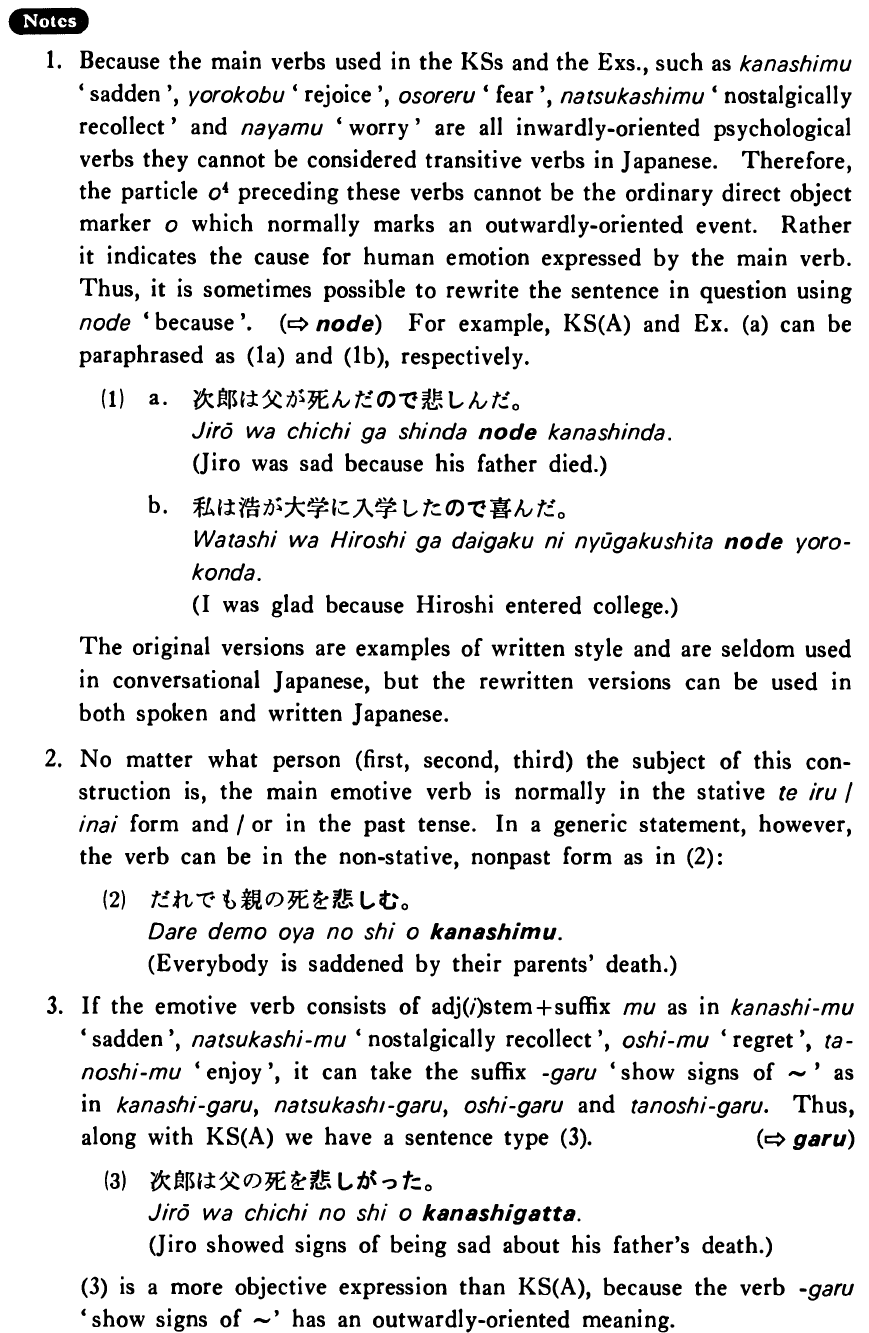
1. Because the main verbs used in the Key Sentences and the Examples, such as 悲しむ 'sadden', 喜ぶ 'rejoice', 恐れる 'fear', 懐かしむ nostalgically recollect' and 悩む 'worry' are all inwardly-oriented psychological verbs they cannot be considered transitive verbs in Japanese. Therefore, the particle を4 preceding these verbs cannot be the ordinary direct object marker を which normally marks an outwardly-oriented event. Rather it indicates the cause for human emotion expressed by the main verb. Thus, it is sometimes possible to rewrite the sentence in question using ので 'because'. (⇨ ので) For example, Key Sentence (A) and Example (a) can be paraphrased as (1a) and (1b), respectively.
The original versions are examples of written style and are seldom used in conversational Japanese, but the rewritten versions can be used in both spoken and written Japanese.
2. No matter what person (first, second, third) the subject of this construction is, the main emotive verb is normally in the stative ているい/ない form and/or in the past tense. In a generic statement, however, the verb can be in the non-stative, nonpast form as in (2):
3. If the emotive verb consists of adjective い stem + suffixむ as in 悲しむ 'sadden', 懐かしむ 'nostalgically recollect', 惜しむ 'regret', 楽しむ 'enjoy', it can take the suffix がる 'show signs of ~' as in 悲しがる, 懐かしがる, 惜しがる and 楽しがる. Thus, along with Key Sentence (A) we have a sentence type (3).
(⇨ がる)
(3) is a more objective expression than Key Sentence (A), because the verb がる 'show signs of ~' has an outwardly-oriented meaning.