Auxiliary Adjective (な) (Basic ㊦ 547)
An auxiliary な type adjective which expresses the likelihood of something/someone or the likeness of something/someone to something/someone.
Equivalent: Look like; look as if; be like; appear; seem
| (i) {V/Adjective い} informal | ようだ | |
| {話す /話した} ようだ | It seems that someone (will) talk/talked | |
| {高い /高かった} ようだ | It seems that something is/was expensive | |
| (ii) Adjective な stem | {な/だった} ようだ | |
| {静かな/静かだった} ようだ | It seems that something is/was quiet | |
| (iii) Noun | {の/だった} ようだ | |
| {先生の/先生だった} ようだ | It seems that someone is/was a teacher | |
| (iv) Demonstrative | ようだ | |
| そのようだ | It seems so |
1. ようだ expresses the likelihood of something/someone, or the likeness of something/someone to something/someone. In either case, when the speaker uses ようだ, his statement is based on firsthand, reliable information (usually visual information).
2. ようだ can be used in counter-factual situations, as in Ex. (d). In this case, the adverb まるで 'just' can be used for emphasis.
3. ようだ is a な type adjective and has the prenominal form ような and the adverbial form ように. (⇨ ように2) Examples:
4. The colloquial version of ようだ is みたいだ, which is also a な type adjective. The uses of みたいだ are exactly the same as those for ようだ. The formation rules are as follows:
【Related Expressions】
The conjecture expressions Sentenceだろう, Sentenceらしい and Sentenceそうだ2 convey ideas similar to Sentenceようだ. The differences are as follows:
(A)
(B)
(C)
(D)
The following examples demonstrate the differences among these four expressions. The sentences in [1] present examples with the adjective 高い 'expensive' before the conjecture auxiliaries.
[1]
Here, [1a] is mere conjecture, [1b] expresses the speaker's conjecture based on what he has heard and/or read. (If the sentence involves little conjecture, it is almost like hearsay. (⇨ そうだ1)) [1c] is also the speaker's guess, but in this case it is based on what he sees. [1d] expresses the speaker's judgment about the price of the book. Note that in [1d] the speaker knows the book's price; therefore, this is not a guess. [2] provides examples with the noun 先生 'teacher' preceding the conjecture words. The differences in meaning among the sentences here are the same as those explained in [1], except that [2c] is ungrammatical.
[2]
In [3], the verb 降る 'fall' precedes the conjecture auxiliaries.
[3]
Here, [3a] is the speaker's guess. [3b] is the speaker's conjecture based on what he heard or it is almost like hearsay. [3c] is also the speaker's guess, but, in this case, he is probably looking at the sky. Like [3c], [3d] is based on what the speaker sees, but in this case the information is reliable, and involves the speaker's reasoning process.
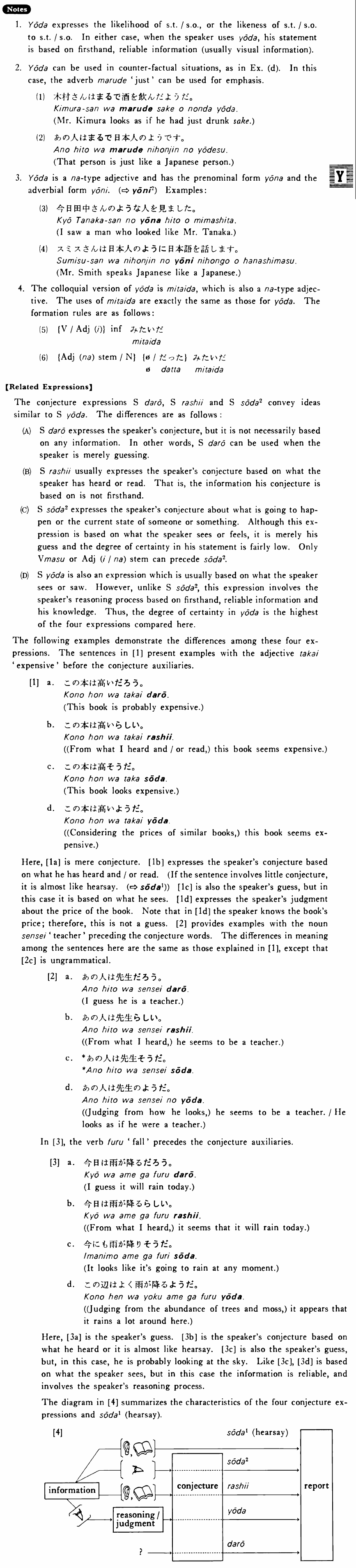
The diagram in [4] summarizes the characteristics of the four conjecture expressions and そうだ1 (hearsay).
[4]
| information→ | [耳],[本]→ | そうだ1 (hearsay) | →report | |
| information→ | [目]→ | conjecture→ | そうだ2 | →report |
| information→ | [耳],[本]→ | conjecture→ | らしい | →report |
| information→ | reasoning/judgment→ | conjecture→ | ようだ | →report |
| information→ | ?→ | conjecture→ | だろう | →report |