Phrase (Basic ㊦ 87)
A phrase which expresses the speaker’s regret.
Equivalent: I wish ~ had done something
| (i) Group 1 verbs | Vconditionalばよかった | |
| 話せばよかった | I wish someone had talked | |
| (ii) Group 2 verbs | Vstemればよかった | |
| 食べればよかった | I wish someone had eaten | |
| (iii) Irregular verbs | 来る→来ればよかった | I wish someone had come |
| する→すればよかった | I wish someone had done |
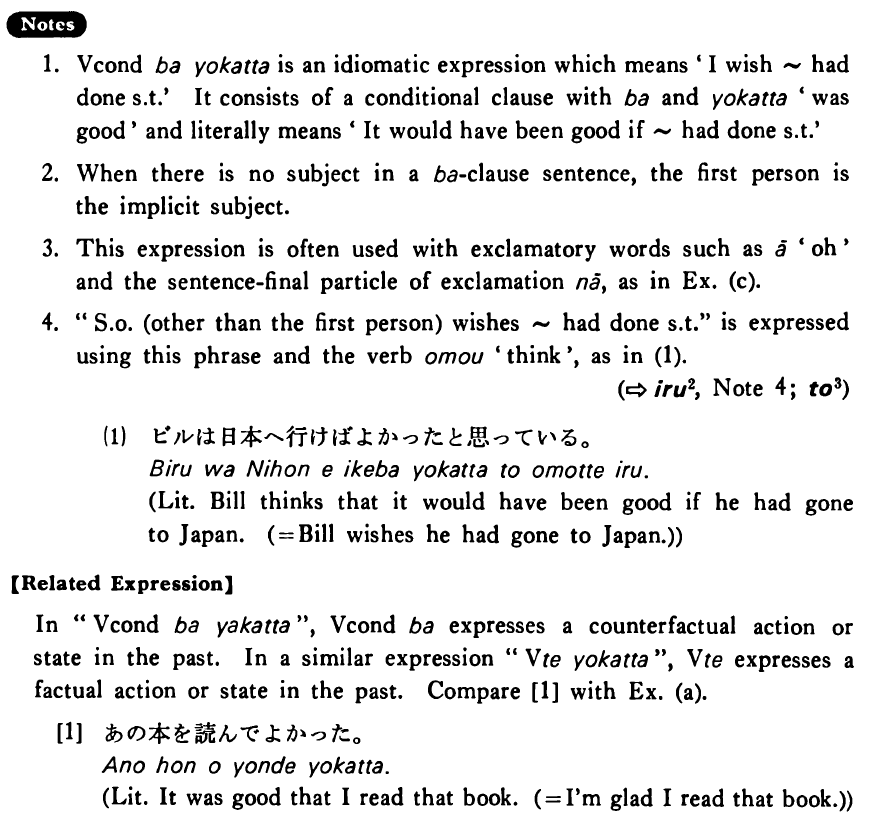
1. Verb conditionalばよかった is an idiomatic expression which means 'I wish ~ had done something.' It consists of a conditional clause with ば and よかった 'was good' and literally means 'It would have been good if ~ had done something.'
2. When there is no subject in a ば cause sentence, the first person is the implicit subject.
3. This expression is often used with exclamatory words such as ああ 'oh' and the sentence-final particle of exclamation なあ, as in Example (c).
4. "Someone (other than the first person) wishes ~ had done something" is expressed using this phrase and the verb 思う 'think', as in (1).
【Related Expression】
In "Verb conditionalばよかった", Verb conditionalば expresses a counterfactual action or state in the past. In a similar expression "Verbてよかった", Verbて expresses a factual action or state in the past. Compare [1] with Example (a).
[1]