Particle (Basic ㊦ 299)
A particle which indicates the location where someone or something exists.
Equivalent: In; at; on
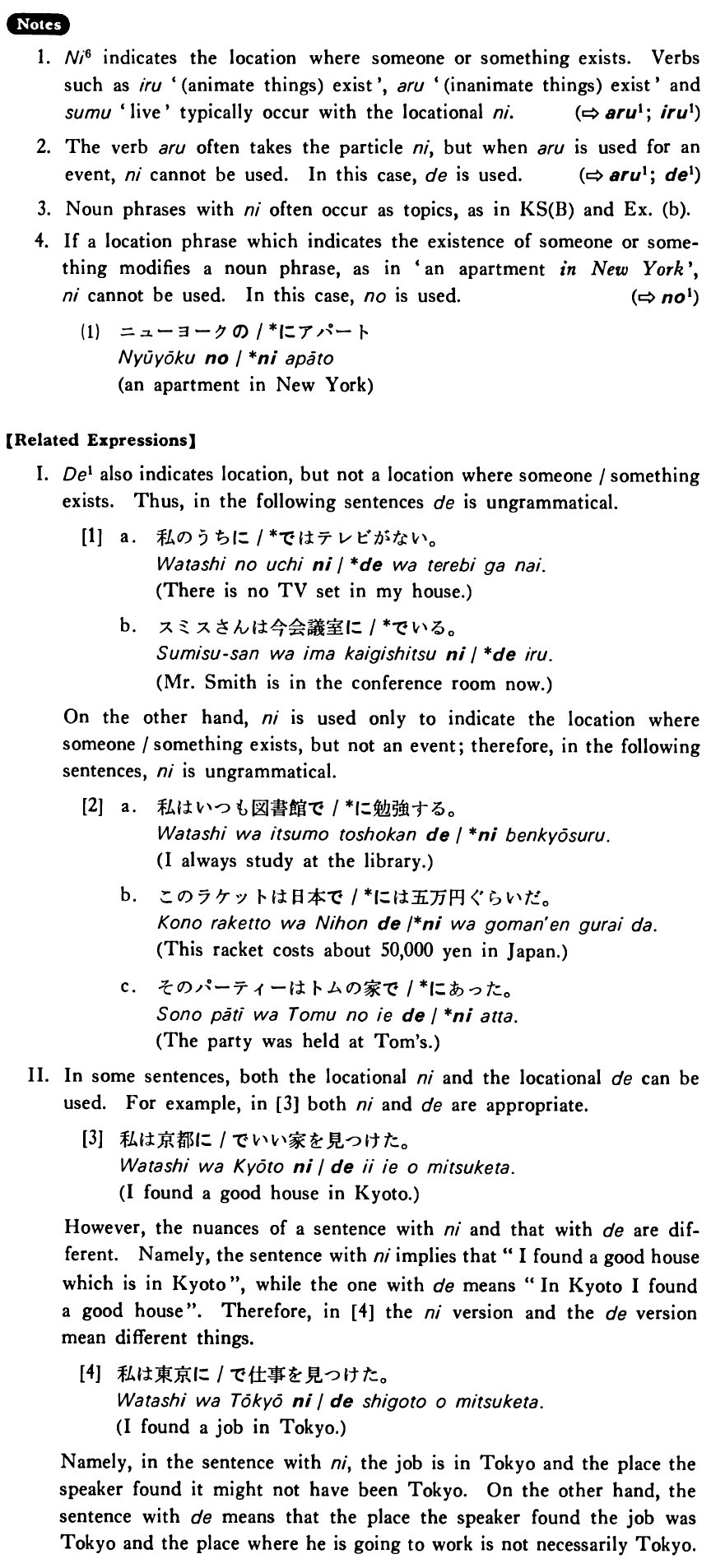
1. に6 indicates the location where someone or something exists. Verbs such as いる '(animate things) exist', ある '(inanimate things) exist' and 住む 'live' typically occur with the locational に.
(⇨ ある1; いる1)2. The verb ある often takes the particle に, but when ある is used for an event, に cannot be used. In this case, で is used.
3. Noun phrases with に often occur as topics, as in Key Sentence (B) and Example (b).
4. If a location phrase which indicates the existence of someone or something modifies a noun phrase, as in 'an apartment in New York', に cannot be used. In this case, の is used.
(⇨ の1)
【Related Expressions】
I. で1 also indicates location, but not a location where someone/something exists. Thus, in the following sentences で is ungrammatical.
[1]
On the other hand, に is used only to indicate the location where someone/something exists, but not an event; therefore, in the following sentences, に is ungrammatical.
[2]
11. In some sentences, both the locational に and the locational で can be used. For example, in [3] both に and で are appropriate.
[3]
However, the nuances of a sentence with に
and that with で are different. Namely, the sentence with に implies that "I found a good house which is in Kyoto", while the one with で means "In Kyoto I found a good house". Therefore, in [4] the に version and the で version mean different things.[4]
Namely, in the sentence with に, the job is in Tokyo and the place the speaker found it mignt not have been Tokyo. On tne other hand, the sentence with で means that the place the speaker found the job was Tokyo and the place where he is going to work is not necessarily Tokyo.