Particle (Basic ㊦ 292)
A particle that indicates an agent or a source in passive, causative, もらう/てまらう and other receiving constructions.
Equivalent: By; from
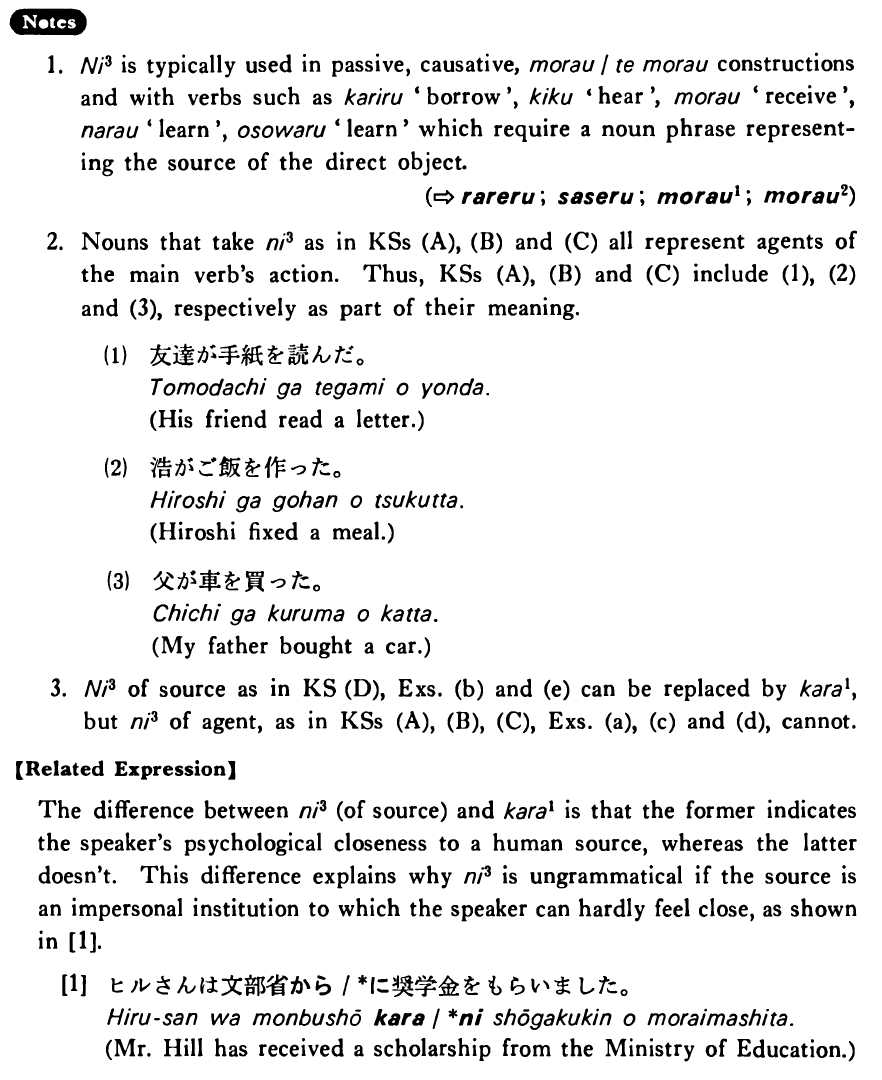
1. に3 is typically used in passive, causative, もらう/てもらう constructions and with verbs such as 借りる 'borrow', 聞く 'hear', もらう 'receive', 習う 'learn', 教わる 'learn' which require a noun phrase representing the source of the direct object.
2. Nouns that take に3 as in Key Sentences (A), (B) and (C) all represent agents of the main verb's action. Thus, Key Sentences (A), (B) and (C) include (1), (2) and (3), respectively as part of their meaning.
3. に3 of source as in Key Sentence (D), Examples (b) and (e) can be replaced by から1, but に3 of agent, as in Key Sentences (A), (B), (C), Examples (a), (c) and (d), cannot.
【Related Expression】
The difference between に3 (of source) and から1 is that the former indicates the speaker's psychological closeness to a human source, whereas the latter doesn't. This difference explains why is ungrammatical if the source is an impersonal institution to which the speaker can hardly feel close, as shown in [1].
[1]