Phrase (Basic ㊦ 279)
A て form of the negative ない, which indicates a cause/reason for a state or action.
Equivalent: Do not do something and ~; is not ~ and ~; because ~ do not do something
| (i) Vinformal negative | なくて | Where V is often a potential verb |
| {話さ /話せ} なくて | Someone doesn’t/can’t talk and ~ | |
| {食べ /食べられ} なくて | Someone doesn’t/can’t eat and ~ | |
| (ii) Adjective い stem | くなくて | |
| 高くなくて | Something isn’t expensive and ~ | |
| (iii) {Adjective な stem/ N} | {では/じゃ} なくて | |
| {静かでは/静かじゃ} なくて | Something isn’t quiet and ~ | |
| {先生では/先生じゃ} なくて | Someone isn’t a teacher and ~ |
【Related Expressions】
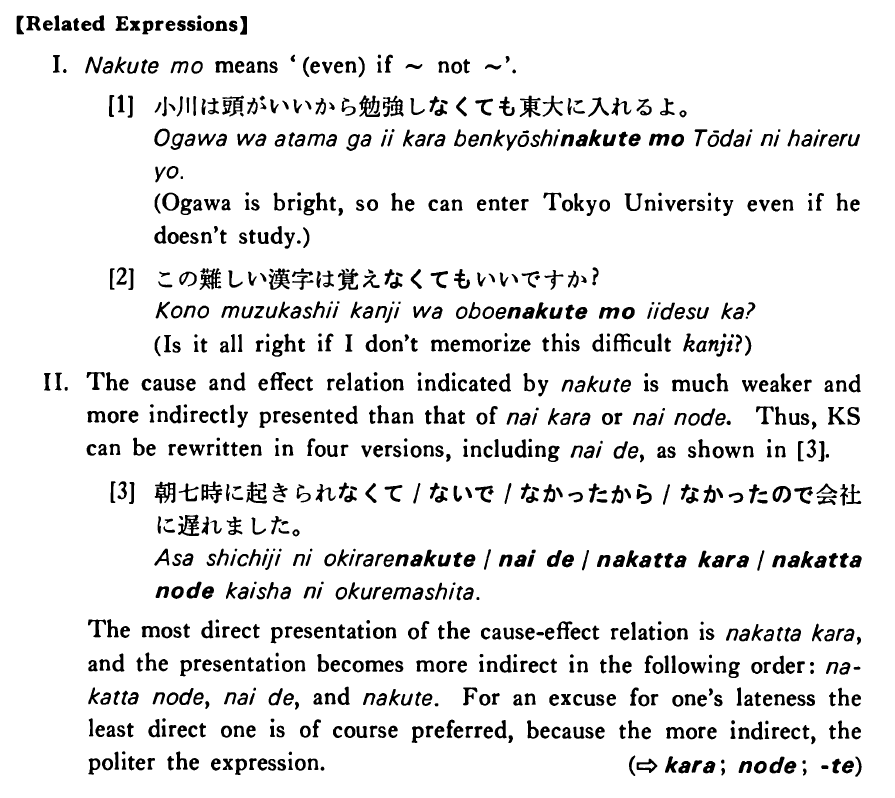
I. なくても means '(even) if ~not ~'.
[1]
[2]
II. The cause and effect relation indicated by なくて is much weaker and more indirectly presented than that of ないから or ないので. Thus, Key Sentence can be rewritten in four versions, including ないで, as shown in [3].
[3]
The most direct presentation oi tne cause-effect relation is なかったから, and the presentation becomes more indirect in the following order: なかったので, ないで and なくて. For an excuse for one's lateness the least direct one is of course preferred, because the more indirect, the politer the expression.