Phrase (Basic ㊦ 486)
A phrase marking information which identifies or explains the noun following the phrase.
Equivalent: Called; that says ~; that
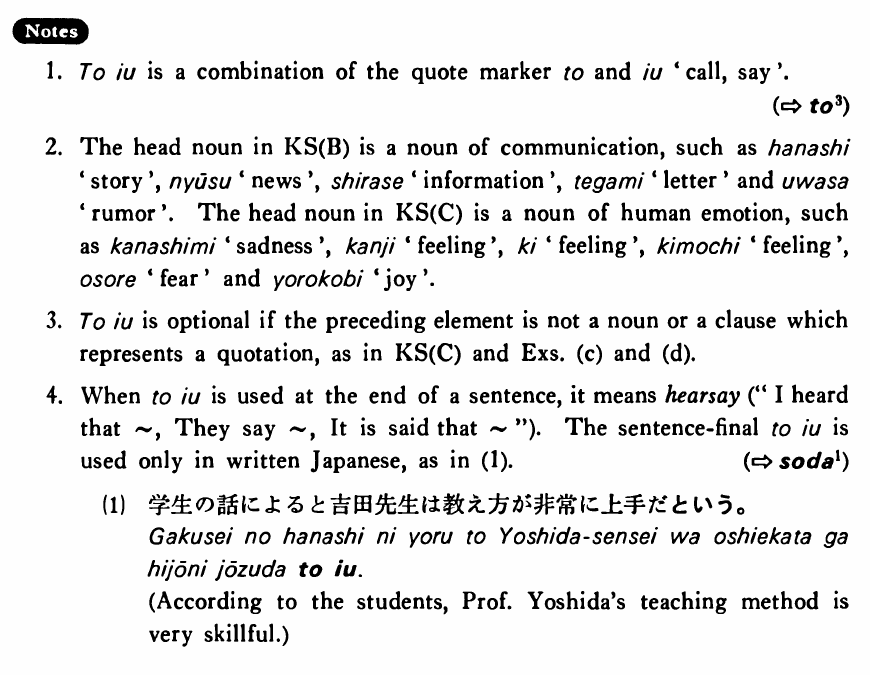
1. という is a combination of the quote marker と and いう 'call, say'.
(⇨ と3)
2. The head noun in Key Sentence (B) is a noun of communication, such as 話 'story', ニュース 'news', 知らせ 'information', 手紙 'letter' and 噂 'rumor'. The head noun in Key Sentence (C) is a noun of human emotion, such as 悲しみ 'sadness', 感じ 'feeling', 気 'feeling', 気持ち 'feeling', 恐れ 'fear' and 喜ぶ 'joy'.
3. という is optional if the preceding element is not a noun or a clause which represents a quotation, as in Key Sentence (C) and Examples (c) and (d).
4. When という is used at the end of a sentence, it means hearsay ("I heard that ~, They say ~, It is said that ~"). The sentence final という is used only in written Japanese, as in (1).
(⇨ そうだ1)