Particle (Basic ㊦ 107)
A particle (apparently derived from the て form of です) that indicates a weak causal relationship.
Equivalent: And; because of; due to; because
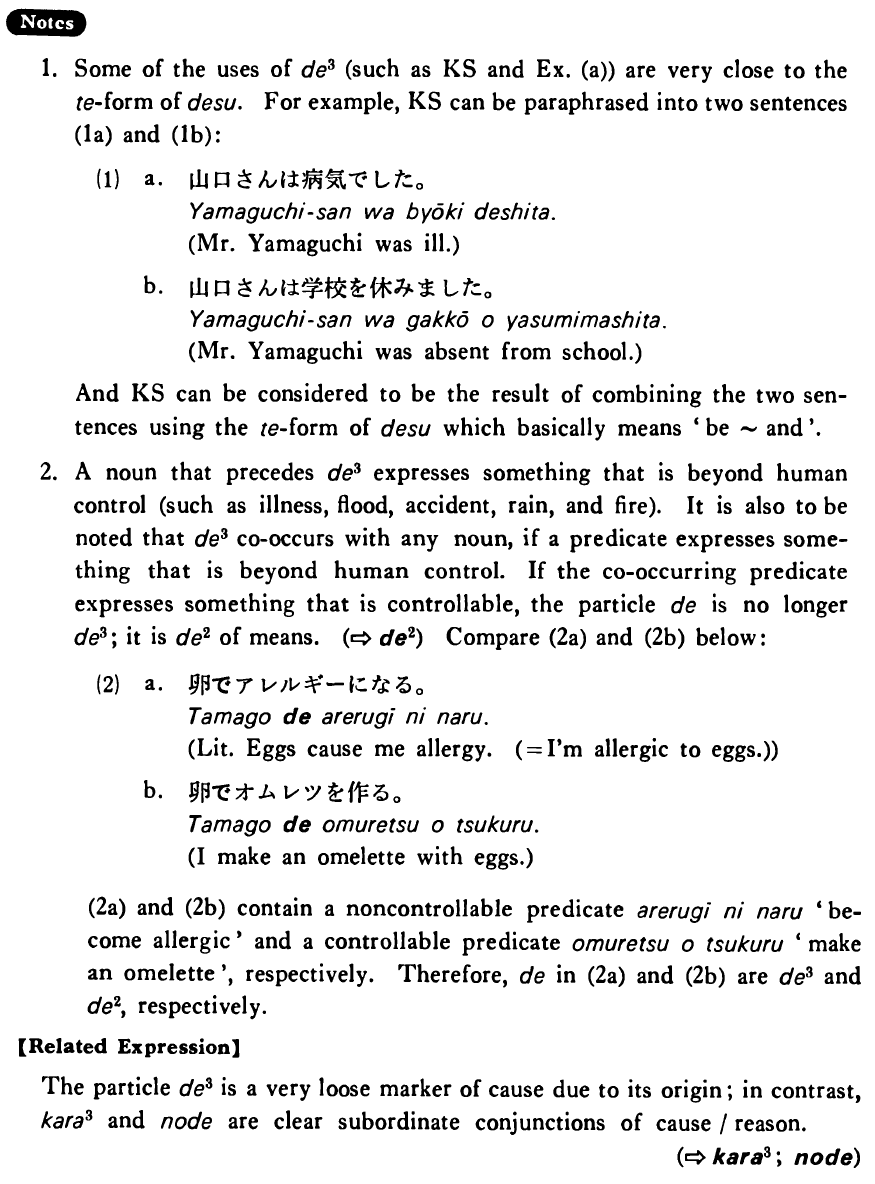
1. Some of the uses of で3 (such as Key Sentence and Example (a)) are very close to the て form of です. For example, Key Sentence can be paraphrased into two sentences (1a) and (1b):
And Key Sentence can be considered to be the result of combining the two sentences using the て form of です which basically means 'be ~and'.
2. A noun that precedes で3 expresses something that is beyond human control (such as illness, flood, accident, rain, and fire). It is also to be noted that で3 co-occurs with any noun, if a predicate expresses something that is beyond human control. If the co-occurring predicate expresses something that is controllable, the particle で is no longer で3; it is で2 of means. (⇨ で2) Compare (2a) and (2b) below:
(2a) and (2b) contain a noncontrollable predicate アレルギーになる 'become allergic' and a controllable predicate オムレツを作る 'make an omelette', respectively. Therefore, で in (2a) and (2b) are で3 and で2, respectively.
【Related Expression】
The particle で3 is a very loose marker of cause due to its origin; in contrast, から3 and ので are clear subordinate conjunctions of cause/reason.