Auxiliary (Basic ㊦ 407)
An auxiliary which indicates that the information expressed by the preceding sentence is what the speaker heard.
Equivalent: I hear that ~; I heard that ~; people say that ~
| (i) {V/Adjective い} informal | そうだ | |
| {話す /話した} そうだ | I heard that someone (will) talk/talked | |
| {高い /高かった} そうだ | I heard that something is/was expensive | |
| (ii) {Adjective な stem/ Noun} | {だ/だった} そうだ | |
| {静かだ/静かだった} そうだ | I heard that something is/was quiet | |
| {先生だ/先生だった} そうだ | I heard that someone is/was a teacher |
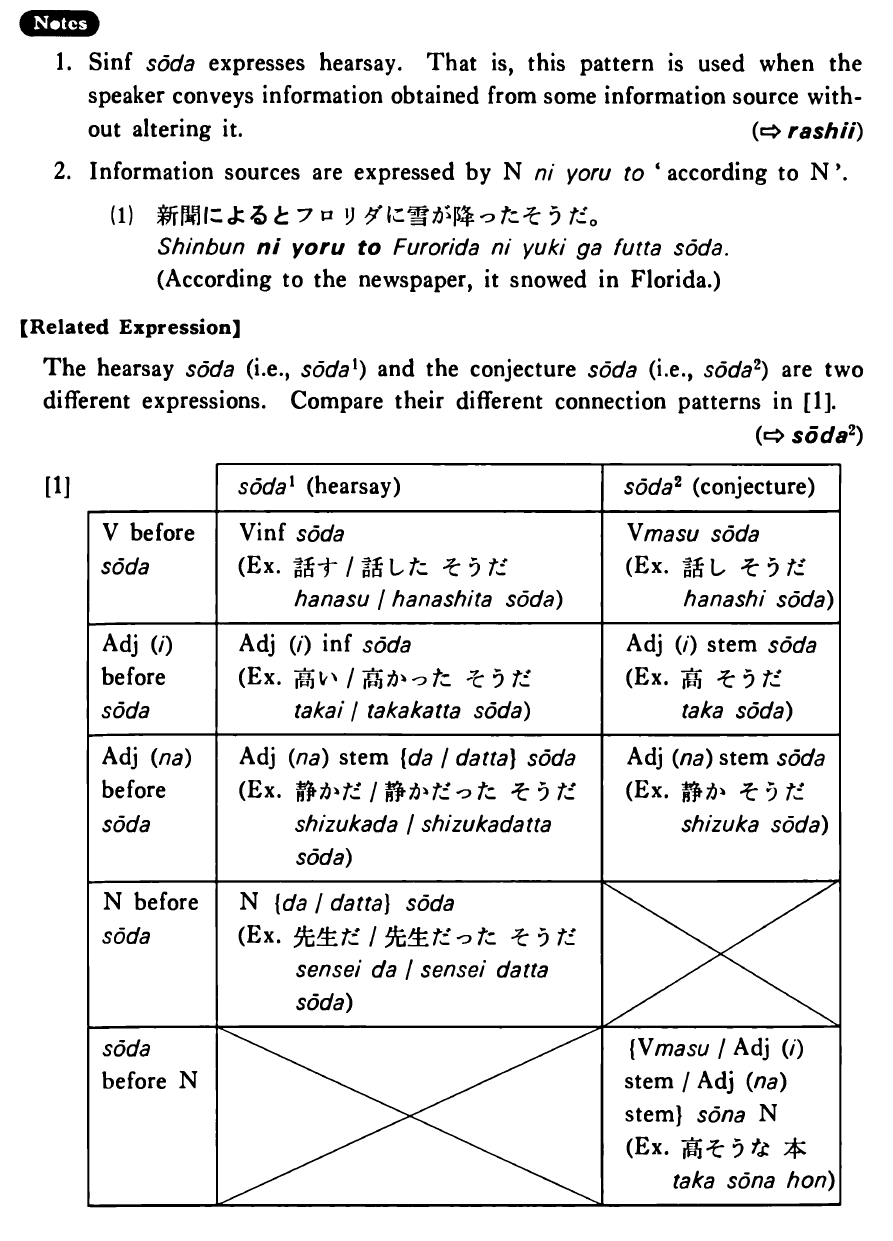
1. Sentence informal そうだ expresses hearsay. That is, this pattern is used when the speaker conveys information obtained from some information source without altering it.
(⇨ らしい)
2. Information sources are expressed by Noun によると 'according to Noun'.
【Related Expression】
The hearsay そうだ (i.e., そうだ1) and the conjecture そうだ (i.e., そうだ2) are two different expressions. Compare their different connection patterns in [1].
(⇨ そうだ2)
[1]
| そうだ1 (hearsay) | そうだ2 (conjecture) | |
| Verb before そうだ | Verb informal そうだ Example: 話す/話したそうだ | Verb ますそうだ Example: 話しそうだ |
| Adjective い before そうだ | Adjective い informal そうだ Example: 高い/高かったそうだ | Adjective い stem そうだ Example: 高そうだ |
| Adjective な before そうだ | Adjective な stem {だ/だった} そうだ Example: 静かだ/諍かだったそうだ | Adj な stem そうだ Example: 静かそうだ |
| Noun before そうだ | Nound {だ/だった} そうだ Example: 先生だ/先生だったそうだ | X |
| そうだbefore Noun | X | [Verb ます/Adjective い stem/Adjective な stem} そうな Noun Example: 高そうな本 |