Particle (Basic ㊦ 398)
A particle which marks an element X when nothing but X makes the expressed proposition true.
Equivalent: Nothing/nobody/no ~ but; only
| (i) Noun | しか | |
| 先生が(subject)→ | 先生しか | No one but the teacher |
| 先生を(direct object)→ | 先生しか | No one but the teacher |
| (ii) Noun+(Particle) | しか | |
| 東京へ・に(direction)→ | 東京(へ・に)しか | To nowhere but Tokyo |
| 先生に(indirect object, agent)→ | 先生(に)しか | No one but the teacher |
| 日曜日に(time)→ | 日曜日(に)しか | Only on Sunday |
| 東京に(location)→ | 東京(に)しか | Only in Tokyo |
| (iii) Noun+Particle | しか | |
| 東京で(location)→ | 東京でしか | Only in Tokyo |
| 車で(means)→ | 車でしか | Only by car |
| 山田さんと(reciprocal)→ | 山田さんとしか | Only with Mr. Yamada |
| 東京から(starting point/source)→ | 東京からしか | Only from Tokyo |
| 五時まで(ending point)→ | 五時までしか | Only till five o’clock |
| (iv) Quantifier | しか | |
| 少ししか | Only a little |
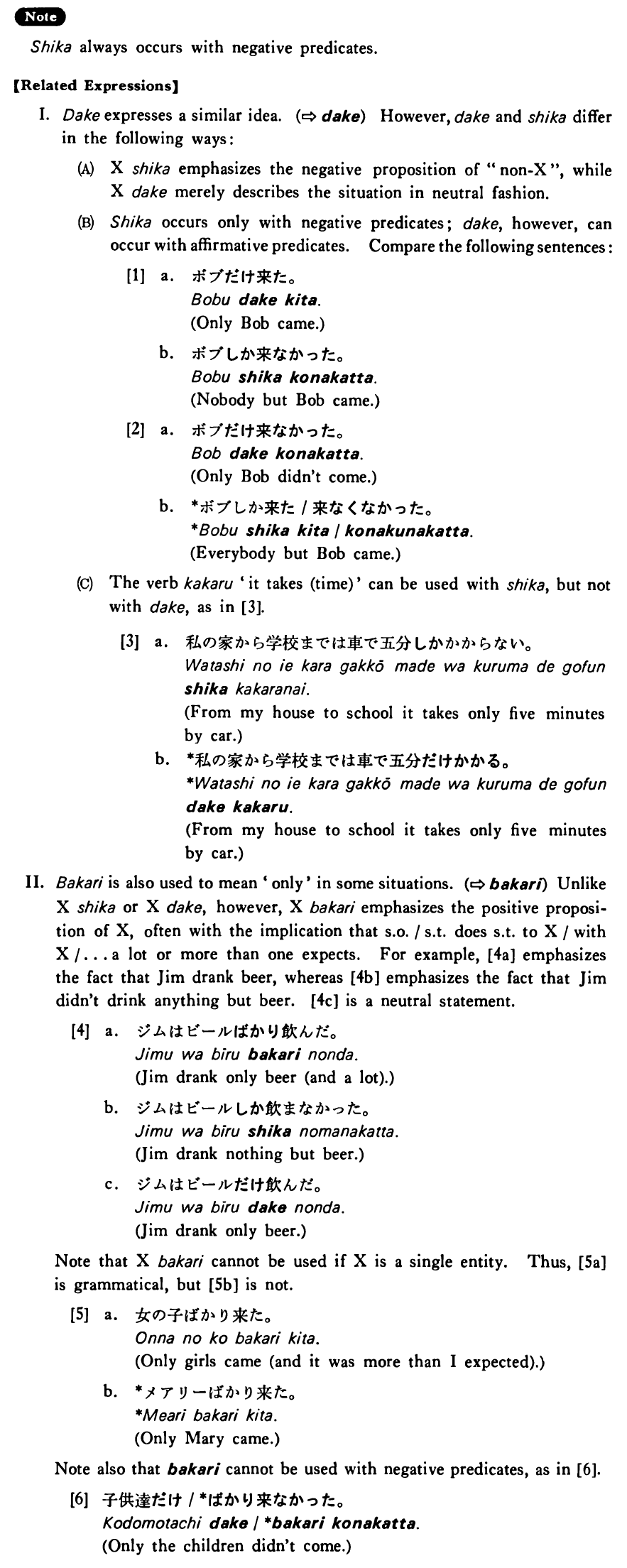
しか always occurs with negative predicates.
【Related Expressions】
I. だけ expresses a similar idea, (⇨ だけ) However, だけ and しか differ in the following ways:
(A)
Xしか emphasizes the negative proposition of "non-X", while Xだけ merely describes the situation in neutral fashion.
(B)
しか occurs only with negative predicates; だけ, however, can occur with affirmative predicates. Compare the following sentences:
[1]
[2]
(C)
The verb かかる 'it takes (time)' can be used with しか, but not with だけ, as in [3].
[3]
II. ばかり is also used to mean 'only' in some situations. (⇨ ばかり) Unlike Xしか or Xだけ, however, Xばかり emphasizes the positive proposition of X, often with the implication that someone/something does something to X/with X/... a lot or more than one expects. For example, [4a] emphasizes the fact that Jim drank beer, whereas [4b] emphasizes the fact that Jim didn't drink anything but beer. [4c] is a neutral statement.
[4]
Note that Xばかり cannot be used if X is a single entity. Thus, [5a] is grammatical, but [5b] is not.
[5]
Note also that ばかり cannot be used with negative predicates, as in [6].
[6]