Particle (Basic ㊦ 170)
A sentence final particle which marks yes-no questions in informal male speech.
| (i) {V/Adjective い informal} | かい | |
| {話す /話した} かい | Does (or will)/Did someone talk? | |
| {高い /高かった} かい | Is/was something expensive? | |
| (ii) {Adjective な stem/ N} | {Ø/だった} かい | |
| {静か /静かだった} かい | Is/was something quiet? | |
| {先生 /先生だった} かい | Is/was someone a teacher? | |
| (iii) {V/Adjective い} informal | のかい | |
| {話す /話した} のかい | Does (or will)/Did someone talk? | |
| {高い /高かった} のかい | Is/was something expensive? | |
| (iv) {Adjective な stem/ Noun} | {な/だった} のかい | |
| {静かな/静かだった} のかい | Is/was something quiet? | |
| {先生な/先生だった} のかい | Is/was someone a teacher? |
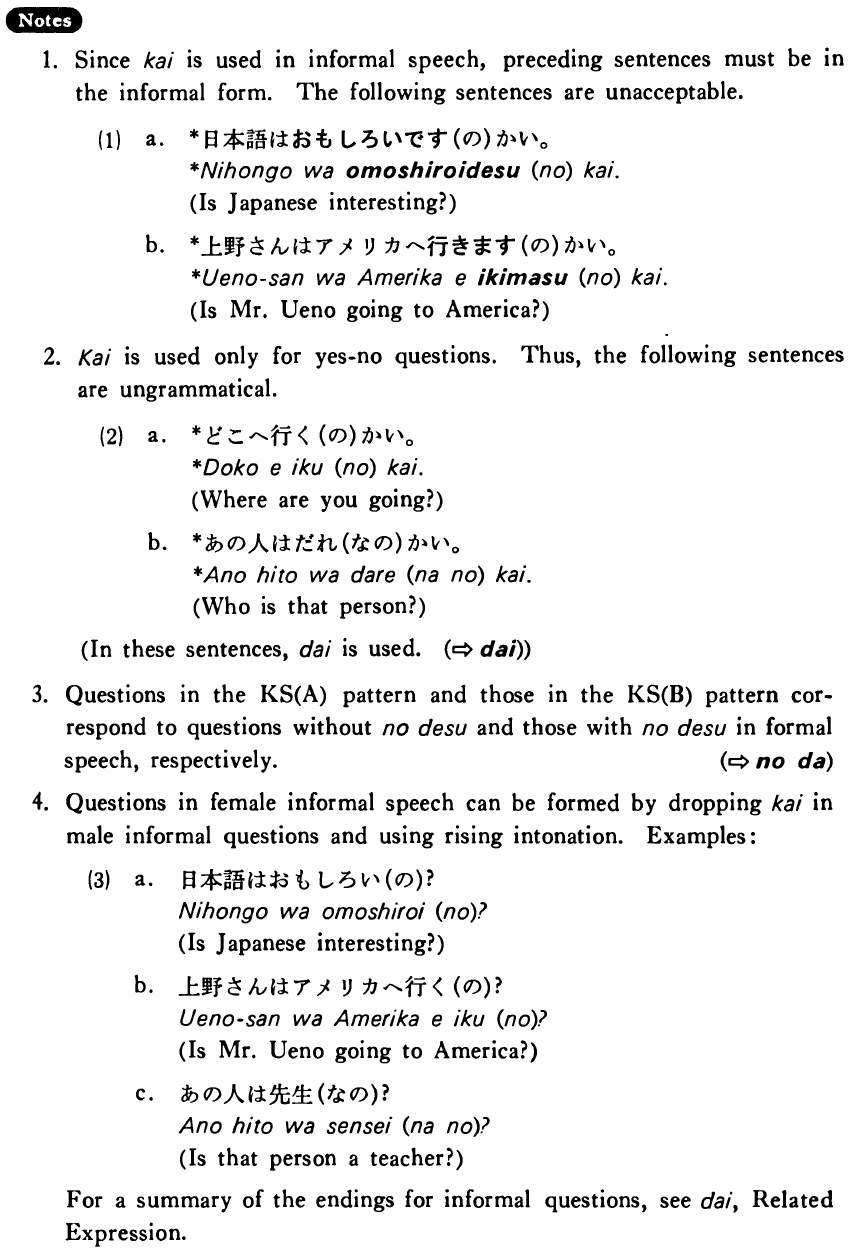
1. Since かい is used in informal speech, preceding sentences must be in the informal form. The following sentences are unacceptable.
2. かい is used only for yes-no questions. Thus, the following sentences are ungrammatical.
In these sentences, だい is used. (⇨ だい)
3. Questions in the Key Sentence (A) pattern and those in the Key Sentence (B) pattern correspond to questions without のです and those with のです in formal speech, respectively.
(⇨ のだ)4. Questions in female informal speech can be formed by dropping かい in male informal questions and using rising intonation. Examples: