Verb (Group 2) (Basic ㊦ 63)
Someone gives something to a person who is not a member of the giver’s in group but whose status is about equal to that of the giver.
Equivalent: Give
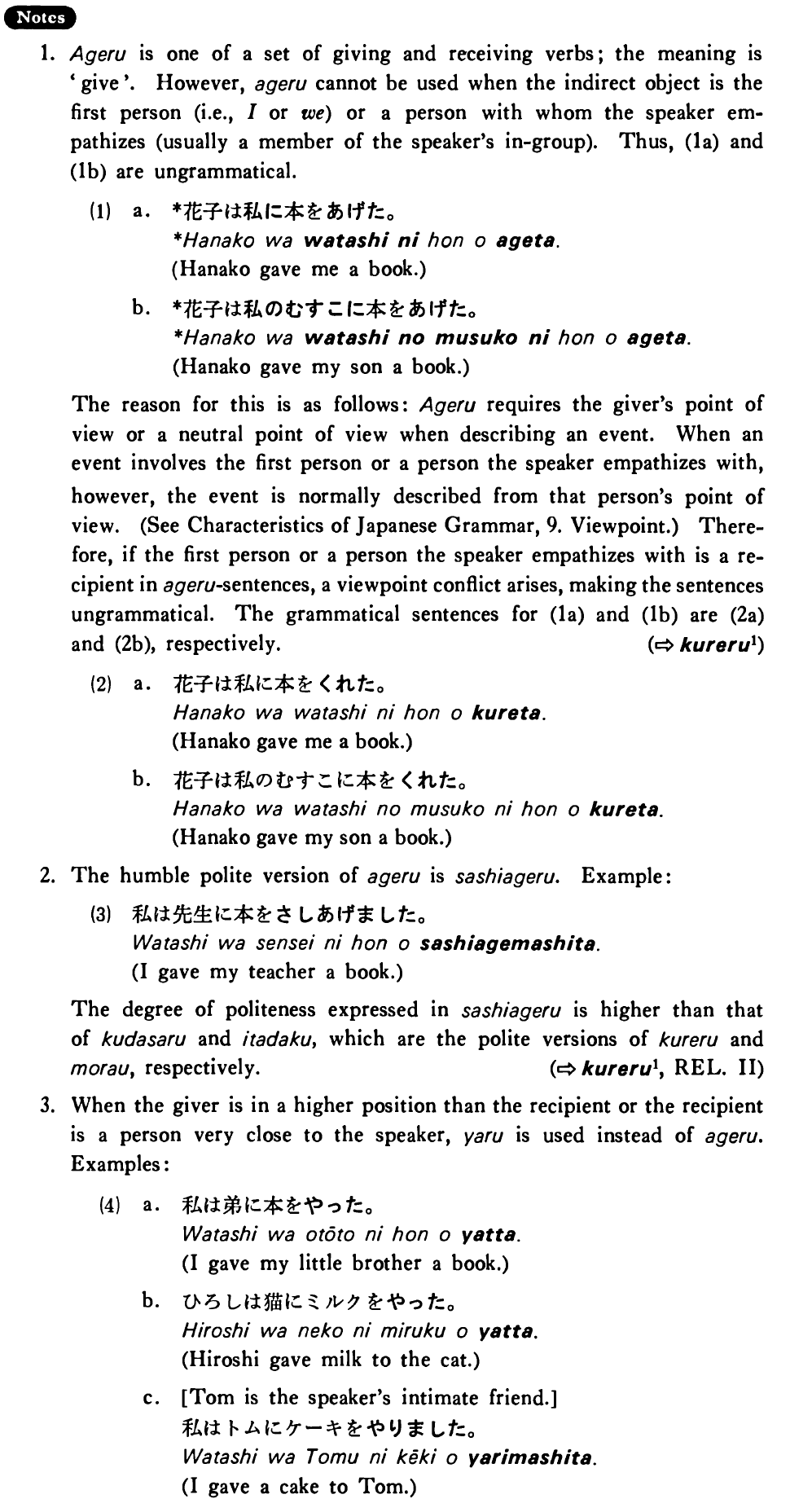
1. あげる is one of a set of giving and receiving verbs; the meaning is 'give'. However, あげる cannot be used when the indirect object is the first person (i.e., I or we) or a person with whom the speaker empathizes (usually a member of the speaker's in-group). Thus, (1a) and (1b) are ungrammatical.
The reason for this is as follows: あげる requires the giver's point of view or a neutral point of view when describing an event. When an event involves the first person or a person the speaker empathizes with, however, the event is normally described from that person's point of view. Therefore, if the first person or a person the speaker empathizes with is a recipient in a あげる sentences, a viewpoint conflict arises, making the sentences ungrammatical. The grammatical sentences for (1a) and (1b) are (2a) and (2b), respectively.
(⇨ くれる1)
2. The humble polite version of あげる is 差し上げる. Example:
The degree of politeness expressed in 差し上げる is higher than that of 下さる and it いただく, which are the polite versions of くれる and もらう, respectively.
(⇨ くれる1, Related expression II)
3. When the giver is in a higher position than the recipient or the recipient is a person very close to the speaker, やる is used instead of あげる. Examples: